
Reflections on Lea Ypi’s Free: Coming of Age at the End of History
by Elena Yrigoyen
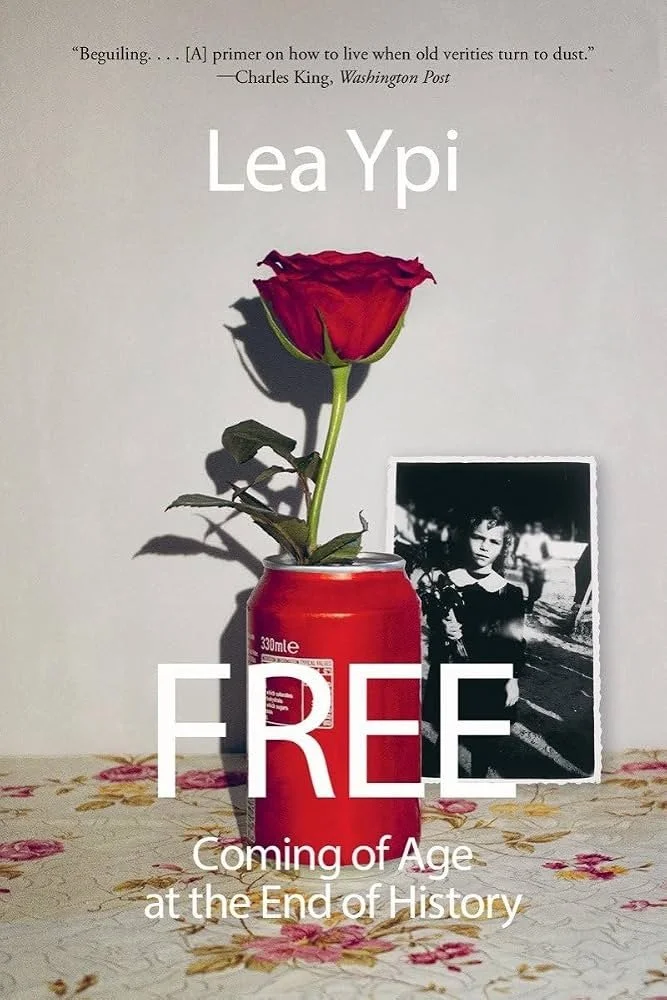
What does it mean to be free? What kind of freedom do we have in capitalist democracies? What is the meaning of democracy?
Lea Ypi’s Free: Coming of Age at the End of History (2021) makes me ask these questions and realize that my standpoint – in some respects determined literally by my historical and geographical location – is also some sort of an ending. It is a different type, though, for she tells the last years of Albanian Stalinism after the Berlin Wall fell and communism failed to be an alternative. I, on the other hand, read this story from the other shore, where capitalist democracies are going through an undeniable multi-systemic crisis: economic, political, social, and ecological. The power of this tale lies in witnessing the collapse and the disappearance of one world, from the vantage point of the other that is itself presently falling apart.
Two classical meanings of freedom are here intertwined[1]: positive and negative liberty. The first, rooted in the Enlightenment and Rousseau's political philosophy, starts from the premise that we are both emotional and rational beings. We feel, want, crave and fear. Yet our everyday desires are often just a form of slavery to our emotional impulses or social pressures. Our only way to be truly free is acting according to our rational self. The Enlightenment twist is, however, that this rational self naturally aligns with the general will. Regardless external forces, irrational impulses, and ignorance, an individual is free as long as acts rationally – that is, according to the common good –. Positive freedom is, then, self-mastery through active participation in collective rule-making. It is precisely this sense of freedom that opened up to the Albanian people in 1991, when the first real elections took place – and when Ypi's family spent the whole day in bed, pretending to be calm and lazy until the last minute, when they finally voted afraid of being caught in a trap.
However, another sense of freedom arises alongside the first one: negative liberty or freedom from interference. If no one is stopping you from speaking, traveling, or practicing your religion, you are “free”. In other words, what makes you free is the absence of external obstacles, constraints, or coercion by others (especially the state). This negative liberty is the liberal recognition of a private sphere the state and others should not intrude upon. Nevertheless, there is a flow among Berlin's interpreters from the “negative freedom” to unrestricted market freedom. Any state regulation of economic activity, like taxes, price controls, or trade restrictions, gets interpreted as interference that reduces individual freedom, regardless of whether that interference aims at some "good" end (redistribution, social protection, etc.) Ypi’s mother – a strong, independent and merciless woman – represents this way of understanding what is to be free. Wanting to portray the self-sufficient, autonomous and competitive individual as the norm, she obscures the relations of care, labor, and mutual dependence that she herself has carried out as a woman and that actually sustains that individual’s freedom.
In just a few months, Albanian people found themselves “free”: on the one hand, supposedly capable of self-organization and self-determination; on the other, liberated from tyrannical state intervention. But, are these two types of freedom compatible? For a classical liberal such as Berlin, the danger was on the positive liberty side. Freedom in the sense of self-mastery could be distorted into justifying authoritarianism. If a state claims to know your "true" or "higher" rational self better than you do, it can justify coercing you "for your own good". Historically, Berlin saw this logic used to justify totalitarian regimes (both fascist and communist) that claimed to liberate people by imposing what the regime deemed their "real" will or "true" interests. For him, then, guaranteeing the lack of state interference was a necessary step to keep democratic rights alive – negative freedom was the condition of possibility for positive freedom.
But, what about the dangers of negative liberty? After the fall of the communist regime and the accelerated transition to the free market, a large part of the Albanian population invested their lifelong savings and sold their properties into investment funds and pyramid schemes that promised sky-high interest rates. This was backed, in one way or another, by the complacency or silence of the government in power at the time. Ypi, a teenager in Tirana at the time, watched as her longtime neighbors and her own family fell into this trap. When the pyramid schemes collapsed one after another in late 1996 and early 1997, citizens lost everything, which led to civil war and the collapse of the country. The abrupt shift from totalitarianism to wild capitalism shattered the Albanian people's belief that negative freedom was the answer to everything. However, when the state abstains from intervening in the economy in the name of negative liberty, it does not eliminate power — it simply transfers it to private actors like corporations and financial markets, who can exercise coercion just as real as the state's through layoffs or precarious working conditions.
It's 2026, and in our liberal democracies, people's capacity to be self-directed is deeply undermined by neoliberal logic and financial capitalism. Negative liberty has long served to defend market freedom — but positive freedom, too, has been reshaped by that same market logic. Once understood as self-mastery rooted in collective rule-making, it has now been stripped of that collectivist core. Following Wendy Brown’s analysis[2], neoliberalism does not just weaken democracy – it hollows out democratic institutions from within while leaving their formal shell intact. It is not just that power shifts to corporations — it is that citizens themselves are re-conceived as "human capital" who must self-invest, self-manage, and enhance their own market value. Being capable of self-governance means now, in a very tricky way, being able to compete, calculate, and optimize your individual economic value.
Authoritarianism and neoliberalism are two shores of the same story, where 'freedom' is a misleading word used to keep coercion, exploitation, and injustice going. After reading Lea Ypi's memoir, I see more clearly that a more fully realized democracy has no room in either of them. In this present multicrisis, and with an unclear future ahead of us, we need to keep weakening neoliberal rationality. One of the places to target is the concept of freedom itself – a field of forces, now taken over by the right but possibly reoccupied as the condition for collective self-government.
Note
[1] Isaiah Berlin, Four Essays on Liberty, Oxford University Press, 1969.
[2] Wendy Brown, Undoing the Demos: Neoliberalism’s Stealth Revolution, Zone Books, 2015.
Elena Yrigoyen is a philospher and writer currently based in Copenhagen. Her interests include literature, philosophy, and anthropology.