
Review: Everything is a Portrait
By Giorgia Monni
“Everything is a Portrait” is the title of the exhibition dedicated to Lucian Freud’s work at the Louisiana Museum of Modern Art, running until 27 September 2026. These four words provide an exhaustive overview of Freud’s vision of art and his artistic philosophy. Freud believed that “Everything is autobiographical and everything is a portrait, even if it’s a chair.” His paintings feature exclusively people (himself included), animals and objects that he could fix his own gaze on. Freud’s visceral realism sought to unsettle the viewer by showing the raw psychological interiority of his sitters. “Intensifying his gaze, getting closer to the subject and coaxing new insight from it, remained his method even as his style changed over the years” [1]. It is no surprise, then, to discover that Lucian Freud would always begin a portrait with the eyes, the initial point of contact. Art critic and historian Martin Gayford, who sat for over one-hundred and twenty hours for his portrait, has kept a diary of his experience. Journal entries from each day spent as a sitter in Freud’s London studio, including snapshots of conversations with the painter and insights into his vision on art and life are collected in The Man with a Blue Scarf: On Sitting for a Portrait by Lucian Freud (2010). Freud’s focus on the eyes is mentioned in one of Gayford’s first entries: “The whorls, spokes and spots of the iris – so finely drawn in LF’s works of over a half a century ago, such as Man at Night (Self-Portrait)(1947-48) – differ slightly in every member of the human race” [2]. Freud was aware of the individuality of absolutely everything.
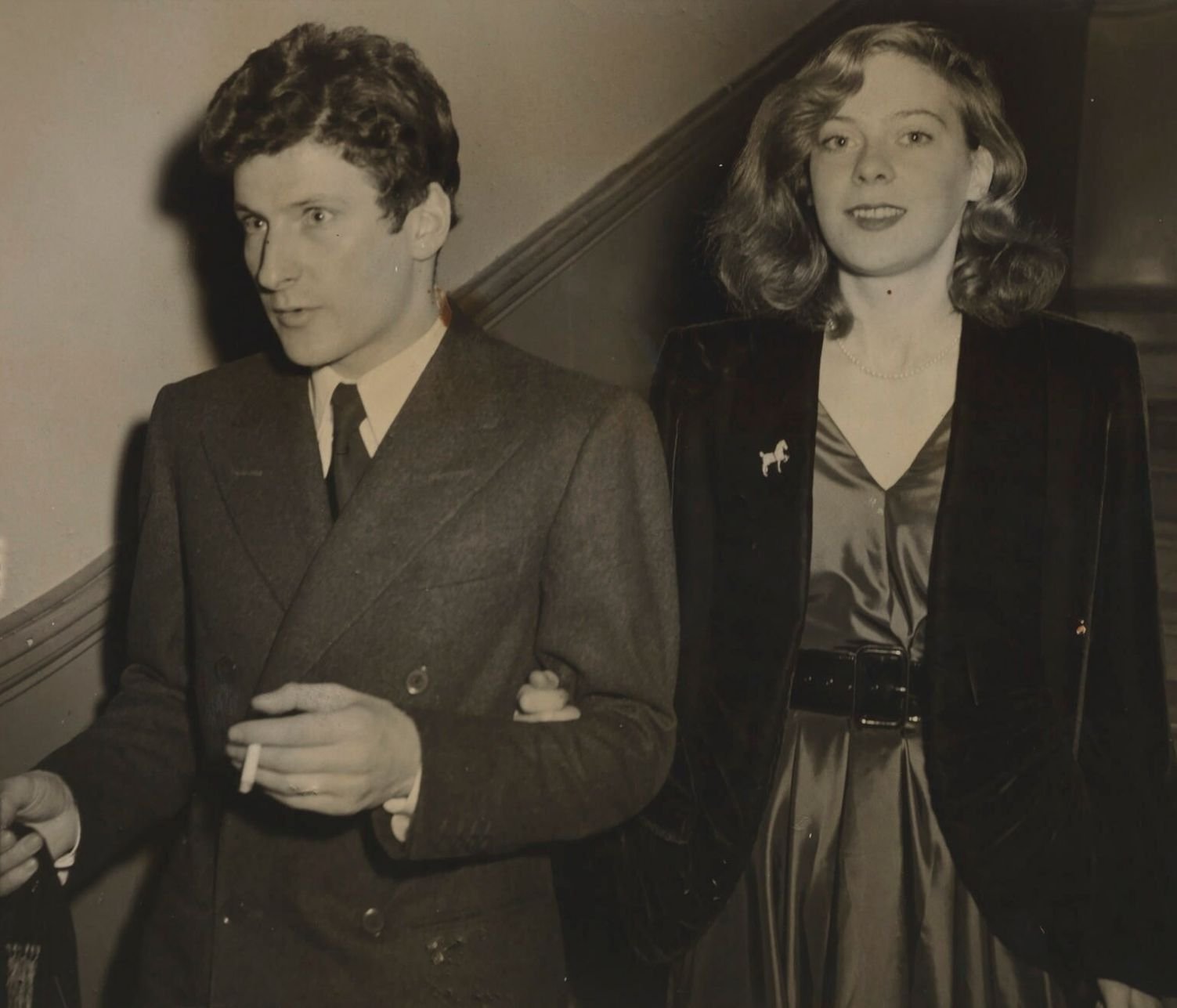
Lucian Freud and Lady Caroline Blackwood leaving Chelsea Register Office, London, following their wedding, 9 December 1953. Photograph via Wikimedia Commons.
During the early 1950s Freud’s encounter with Lady Caroline Blackwood – and, incidentally, the reason I was there – marked a new era of his production. The two married in 1953 and lived a rather tormented Love Story(2026) that makes us question whether they should have based the Disney+ show that kept everyone in a chokehold earlier this year on another Caroline entirely. Not Carolyn, admittedly, but close enough. Five portraits, several sketches and a love letter survived from their union. In Girl In Bed (1952), Caroline Blackwood, at the time aged twenty-one, was yet to become the renowned writer that she would be decades later. For a long time, she remained known primarily through her connections: Freud’s young wife, Lowell’s tragic widow, the cursed Guinness heiress. Why do some women become icons, while others become footnotes in the biographies of their loved ones? This thought came to me as I walked in the beautiful Louisiana Museum garden to discover the work of an artist whose work, embarrassingly, I was not familiar with, but that I rather knew from being the former husband of a writer that turned me into a reader. Blackwood’s novels taught me that reading can be an act of investigation: that a sentence can conceal more that it reveals, and that characters can remain elusive without ever being distant to the reader. Blackwood’s prose resists being rushed; it asks to slow down and linger over a sentence, to reread a passage, to notice how one word seems inevitable and that another would not do. She lures the reader into unsettling yet ordinary worlds, revealing the grotesque with remarkable composure without ever sacrificing precision. Somewhere in the slowing down, I became the kind of reader who could no longer leave a book at the surface.
In his work of the late 1940s and early 1950s, this concentration on uniqueness was expressed in extraordinary levels of surface detail. His portraits of that time seem to itemize every hair on his subjects’ heads. They include such minutiae of appearance as the markings in the irises of their eyes, and individual eyelashes. [...] The eyes and the hair, at that stage, seemed especially to fascinate him. In terms of biology and psychology, that instinct was absolutely correct. Although it is almost impossible to produce an accurate description in words of any human face beyond generalities – brown hair, big nose, thin lips – in reality each set of human features is minutely individualized. Each is unique. [2]
We could spend hours examining every detail carefully captured in Girl in Bed. The precise outline of her cupid’s bow, her lips slightly chapped, her eyebrows dishevelled by the prolonged contact with the bed sheets, her blond hair worn in a side part, as Blackwood notoriously used to style it, rendered with such precision that it gives the illusion you could run your fingers through it and that you would be able to appreciate its texture. Yet again, the main focus is on the eyes. And as I stood in front of the painting, mesmerized by the perceptive and placid gaze of this woman, I thought of the role of the eyes in Blackwood’s work. In The Fate of Mary Rose (1981), Cressida, the novel’s unsettling and enigmatic central figure, is often described as having a deep, rather disturbing gaze, impossible to decipher, or at least the narrator has always failed to do so. “I found her beauty astonishing. There was a sad expression in her slanted aquamarine eyes and I wondered why she looked so unhappy” [3].
In the introduction to the Virago Modern Classics edition, Camilla Grudova places Caroline Blackwood alongside the “wide-eyed, fragilely luminous Margot Tenenbaum”; this parallelism has stayed with me ever since I read it, and sent me back to re-watch the 2001 Wes Anderson’s masterpiece The Royal Tenenbaums.
In The Fate of Mary Rose, Cressida is depicted as an uncanny, overly-protective mother whose care for her child tips into obsession when Maureen Sutton, a child living in the same village as the two, mysteriously disappears. The Fate of Mary Rose flirts more openly with the thriller genre than any of Blackwood's other novels, but I would not classify it as one. The reader quickly realizes the circumstances of the disappearance, and is left to observe the behaviour of an unsettling woman we only know through the narrator’s eyes, Rowan, Mary Rose’s father and – technically – Cressida’s husband. As Cressida gradually unravels, revealing the more
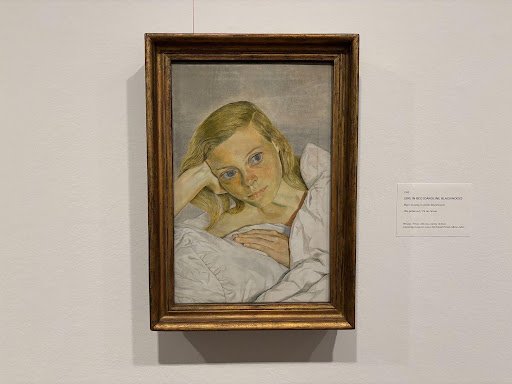
Girl in Bed (1952), by Lucian Freud. Photograph by the author.
unsettling aspects of her personality, the opening line – "She was dead even before I became aware of her existence" [5] – functions less as a page-turning hook than as the trigger for a slow psychological excavation.
If we had been photographed together we might have looked enviable. Both of us in our early thirties. Cressida, so delicate and blonde. Myself, Rowan Anderson, the devoted husband, dark and tall, a man of obvious elegance and education. Oh, we could have looked like an ideally well-matched couple in some photographs! And when we were together all I wanted to do was drink. I loathed the way we had learned to skate so gracefully on the ice of our own politeness. [5]
In 1964, during a lecture he was holding at Norwich College of Arts, Lucian Freud asked his students to make their works “revealing, believable, really shameless”. I cannot quite come up with a better description of Blackwood’s writing. Cressida is disturbingly obsessive, morbid in her actions and compulsive, but all of this is carefully hidden under the mask of an elegant and estimable woman, who lives in a respectable house and conducts an apparently idyllic life. Only through Rowan’s perspective, in a tendency that exponentially grows as the case of disappearance evolves, are we able to discern the decay that lies beneath the façade Cressida displays. Cressida's life unfolds through ritual. Cleaning, watching, arranging, maintaining. The repetition is less the expression of domestic contentment than an attempt to keep something else at bay. To improperly borrow a term coined by Lucian Freud’s grandfather, none other than Sigmund Freud, Cressida appears to be driven by ‘repetition compulsion’, and channels her anxieties into domestic order.
As Vittorio Lingiardi writes in his most recent work, published in Italian with the title Farsi male: variazioni sul masochismo (2026): “Doing things again, returning, repeating, makes us feel safe. [...] When we are afraid of losing ourselves, they give us a house to keep in order. But a house can become a cage, an endless digestion, a Sisyphean task” [6].
The more anxious Cressida becomes, the more she tightens her grip on the house and on her daughter, until this care turns into sweetened confinement. This is a pattern that extends beyond The Fate of Mary Rose. In The Stepdaughter (1976), J. lives in a beautiful high-end New York apartment, yet experiences it less as a home than as a form of detention. Just as the Kent house in The Fate of Mary Rose, the apartment in The Stepdaughter becomes an extension of its occupant's psyche. In Blackwood's fiction, houses rarely shelter; they contain, constrain, and eventually imprison.
When he helped me prepare the new apartment, he was preparing it as if he wanted it to be my last resting place. When he furnished it so expensively, he might just as well have been lining my coffin with velvet. [7]
Another of Freud’s portrait of Blackwood, Hotel Bedroom (1954), features Lady Caroline Blackwood once again in the confines of a bed; in the background, Lucian Freud himself stands at a distance, a detail that feels like an eerie premonition of the relationship's eventual collapse three years later. While the man looks at the viewer with his body turned towards her, the girl’s gaze is directed elsewhere, as she lies on her side of the bed with one hand resting on her cheek. Both look troubled and burdened with unspoken thoughts in this snapshot of ordinary life, in a room that forces them together, an atmosphere more suffocating than intimate.

Hotel Bedroom (1954), by Lucian Freud. Photograph by the author.
And if for Lucian Freud everything in front of him was a portrait, the same can be said for Caroline Blackwood. In each of her characters we can sense fragments of herself and of people from her inner circle. Born in 1931 in London into an Anglo-Irish family, she was the daughter of Basil Hamilton-Temple-Blackwood, 4th Marquess of Dufferin and Ava, and Maureen Guinness. She studied at Oxford and after the completion of her studies, in 1949, she was presented as a debutante. Shortly after she ran off to Paris with Lucian Freud, whom she married in 1953. This caused a considerable scandal in her aristocratic circle, and even greater ones were sparked by her divorce and subsequent two other marriages. She had three daughters and a son from her later unions, and they too found their way into her fiction. The Fate of Mary Rose was written in 1981, almost thirty years after her featuring in Girl in Bed; her third husband, American poet Robert Lowell, had left her to move back to the United States and had reportedly died in the back of a cab in New York while clutching her portrait by Lucian Freud.
Her biography alone is remarkable. As someone who came to Freud through Blackwood, I found myself tracing unexpected correspondences – or rather, speculations – and it was a rather intriguing process to find a common thread between her work and his. To think that two people with such eclectic minds that shaped twentieth-century culture had briefly shared part of their life together is utterly fascinating. Their work is nevertheless independent of one another, and the parallelisms are not meant to reduce either artist to the other. Her fiction makes it impossible to accept her merely as a footnote in someone else's. But the same applies to Lucian Freud. His career stretches over six decades and his works solidified his name as one of the greatest realist painters of the twentieth century. Perhaps Lucian Freud was right; everything can be a portrait, whether painted in oils or written in prose.
If you would like to admire Freud’s work and discover more about his creative process, check out the exhibition here.
About Author: Giorgia Monni, 23, was born in Rome and is currently based in Copenhagen, where she studies materials engineering. Her interests include literature, visual art and writing.
Works Cited
[1] Louisiana Museum of Modern Art, Everything is a Portrait, exhibition held from 11 June 2026 to 27 September 2026. https://louisiana.dk/en/exhibition/lucian-freud-2026/.
[2] Martin Gayford, Man with a Blue Scarf (London: Thames & Hudson, 2010), p. 23.
[3] Caroline Blackwood, The Fate of Mary Rose (London: Virago Modern Classics, 2025), p. 1.
[4] Blackwood, The Fate of Mary Rose, p. 3.
[5] Blackwood, The Fate of Mary Rose, p.54.
[6] Vittorio Lingiardi, Farsi Male: Variazioni Sul Masochismo (Turin: Einaudi, 2026), p. 91. Own translation.
[7] Caroline Blackwood, The Stepdaughter (Kingston, NY: McNally Editions, 2024), p. 35.